By Mohani Niza
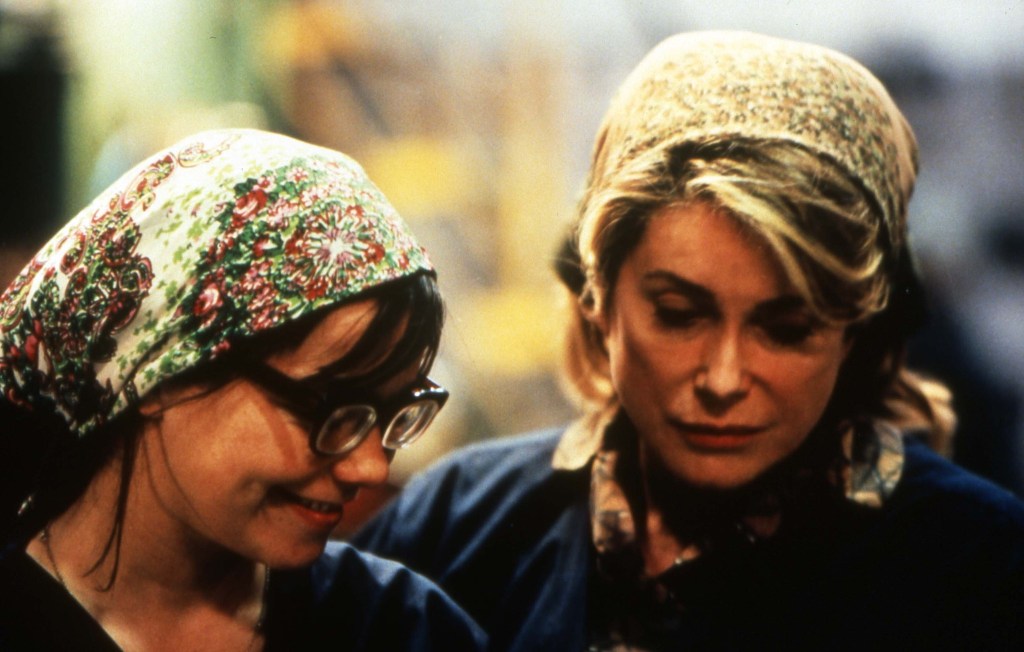
Catherine Deneuve is considered the grand dame of French cinema and has, over her decades-long career, captured the infatuation of both men and women alike. A self-confessed guarded person, she keeps her life private, which heightens her mystery even more.
A stunning beauty and a person who prefers to conceal more than she reveals in her acting, Deneuve has been molded by the best directors of her time – most notably of the likes of François Truffaut to Luis Buñuel, to Roman Polanski.
Now in her golden years, Deneuve has subjected herself to the imagination of the likes of newer filmmakers such as François Ozon, Lars Von Trier, and Arnaud Desplechin, much to the delight of her fans who keep wanting more.
André Téchiné, who has directed her in a number of films, says, “There’s something double or triple about her. I get the impression that she still has a lot left in her. We haven’t yet seen the end of all the magic she can provide, and all of the transformations she can offer the filmmaker.”
Here we deep dive into some of her best movies from her mid-life onwards.
- Indochine (1991, directed by Régis Wargnier)
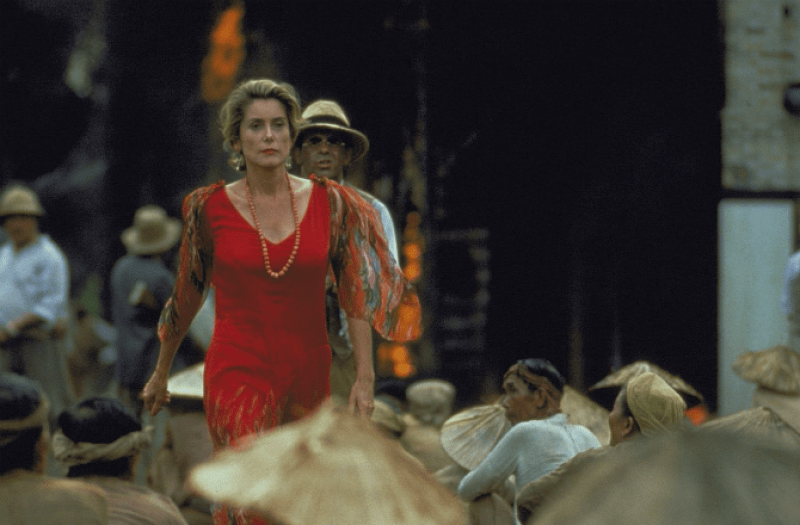
The premise of this sprawling epic is straightforward enough: Eliane, a wealthy landowner, adopts an orphan she names Camille during French Indochina (modern-day Cambodia, Vietnam and Laos).
Her life revolves around her adored daughter and extensive rubber plantation. Ultimately, she and daughter separate.
Though not having been raised in France itself, Eliane is privileged. She controls her estate and her subjects with a cool, almost-masculine demeanor – sometimes protective, but mostly oppressive: she protects a little boy, she whips a male worker for an offense.
Eliane loves Camille, who is sweet and retreating. She tells Camille that nothing differentiates them, despite their skin colour. Camille is pampered, adored and doesn’t stray far – France’s exotic little pet.
But ultimately Indochina decides she no longer wants to be a pet. The turning point of the mother-daughter relationship starts when young and handsome Jean-Baptiste, a naval officer, enters the picture. Eliane’s and Camille’s tranquil life together is rocked.
Eliane falls for him – and so does Camille after she is “saved” by him at a shooting. Jealous and hurt, Eliane orders Jean-Baptiste to be posted to the remote Con Dao islands.
However, Eliane underestimates Camille’s will. Love-struck, Camille sets out cross country to go to Jean-Baptiste. In the process, she is recruited by Communists to fight for independence. Eliane and Camille’s relationship as they know it is never the same again.
Indochine is a superb picture illustrating a mother’s love and control towards her child, and how the dependent child must ultimately separate, a metaphor of the fact that all empires end.
Make no mistake – this is France’s version of the story of the empire she lost. In fact, from the very start of the movie, we hear Eliane narrating the story. Even as Camille is running away through the countryside, it is through Eliane’s lens that we see the voyage. We don’t see Camille’s Communist trainings. The details are unknown to Eliane. Eliane simply imposes her emotions and narration on what transpires, just like an empire imposes and creates the stories of her colonies.
The story is told with a charismatic soundtrack and cinematography. The shots of the Vietnamese countryside and the famous Hạ Long Bay simply take your breath away, alongside with the shots of the misty rubber plantations filmed in Malaysia.
Excellent performances from Deneuve and Linh Dam Pham, whose portrayal of their characters’ outward restraint and control show us their turmoil and pain as mother and daughter vying for the same man.
Deneuve is truly deserving of her Oscar nomination and César win for this movie. Indochine has become one of her celebrated works, and rightly so.
- Dancer in the Dark (2000, directed by Lars Von Trier)
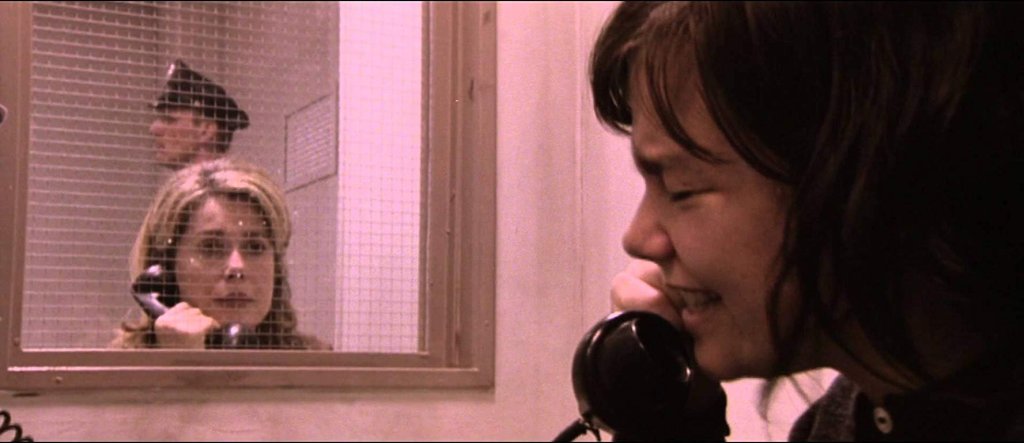
A dramatic portrayal of a young Czech factory worker who is going blind, and her attempt to not let her son suffer the same fate, Dancer in the Dark won the Palme d’Or when it premiered at Cannes in 2000.
Selma (played by Björk) sees the world through a child-like idealism, despite having to work in a bleak factory making industrial sinks in an equally bleak rural town in 1960s America.
She works hard to save money for her son Gene’s eye operation. Whenever her life takes a hard turn – and it often does – she resorts to creating musicals in her head: exploding on the screen here, singing near the train tracks there. It is the only way she can cope in Von Trier’s terrifying dystopian town which ultimately punishes her.
Deneuve lends a hand as Selma’s French immigrant best friend Kathy who is also her colleague. Kathy is fiercely protective and maternal, determined to shield Selma from her naivety.
Selma and Kathy find delight from rehearsing in their small town’s performance of the Sound of Music. In their free time, they also watch old musicals. Of course, Selma cannot really see the cinema screen. She relies on Kathy to tell her what is happening, much to the annoyance of a man in the audience who wants to pay attention. In one tender moment among many others, Kathy takes Selma’s hand in hers and traces the dancers’ steps to illustrate what is happening on the screen.
Fans of Deneuve may see the connection rom her earlier movies, such as The Umbrellas of Cherbourg (1964) and the The Young Girls of Rochefort (1967) – two musicals that launched her career. In Dancer, Deneuve is a woman who has aged gracefully to our delight.
- My Favourite Season (1993, directed by André Téchiné)
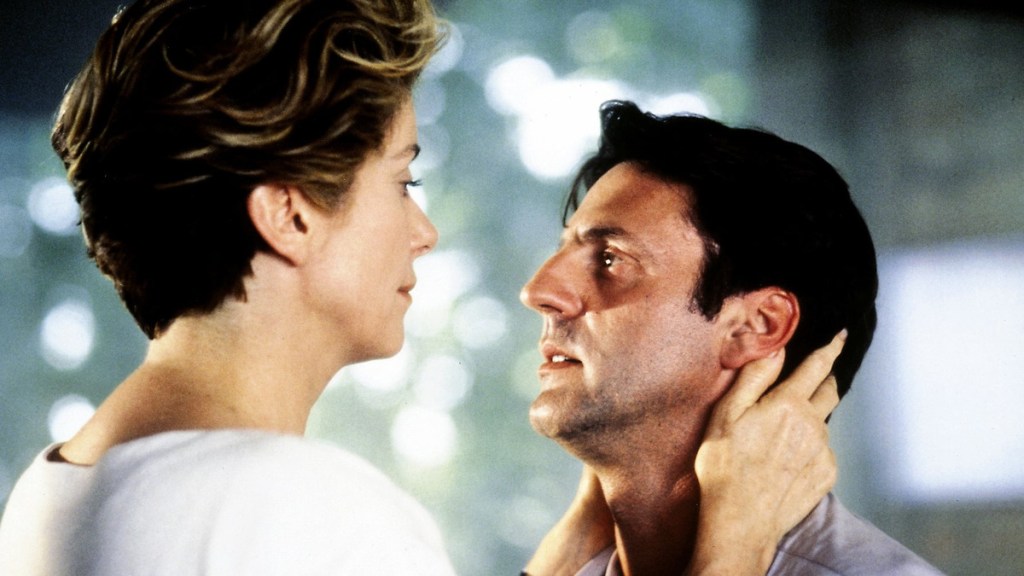
My Favourite Season is an underrated choice even among Deneuve’s most ardent fans. It tells of generational hurt and class divide between a mother and her two adult children.
Berthe (Marthe Villalonga), an old woman who lives on a farm, falls ill and goes to live with her lawyer daughter Emilie (Catherine Deneuve), a woman who gives the impression of calmness but seems dead to the world.
Berthe resents the fake and cold relationship with her daughter. Emilie and her brother Antoine (Daniel Auteuil) are estranged – it has been three years since they parted. Berthe’s situation causes Emilie to invite Antoine for Christmas. Memories come up and Antoine struggles with the intense feelings which are almost forbidden in nature that he secretly has for his sister.
Meanwhile, Emilie sees the empty shell of her household, which has been a façade for a long time, disintegrates as her marriage teeters on the brink of collapse. The loneliness which results causes her daughter Anne (Deneuve’s real-life daughter Chiara Mastroianni) to find a friend and a sister-figure in Khadija (Carmen Chaplin), a young woman bitter and confused about her relationship with boys.
The post-New Wave French director Téchiné weaves a story about intense and painful complex family dynamics, the wide gap which exists between a parent and her children caused by modernity and class differences, and the painful ambiguous feelings siblings have for each other, including taboo incestuous feelings.
Just when we think that Emillie and Antoine have resolved, at least for the moment, their tensions with each other, things take an unexpected turn which pulls back each of their bitterness.
The movie is long, but worth it. There is a lovely poem if you stick to the end. Deneuve is a genius playing Emilie, a woman cold and detached on the outside, but who also has an undercurrent of vulnerability and an emotional core to her.
This is one of Téchinés best works with Deneuve.
- Thieves (1996, directed by André Téchiné)
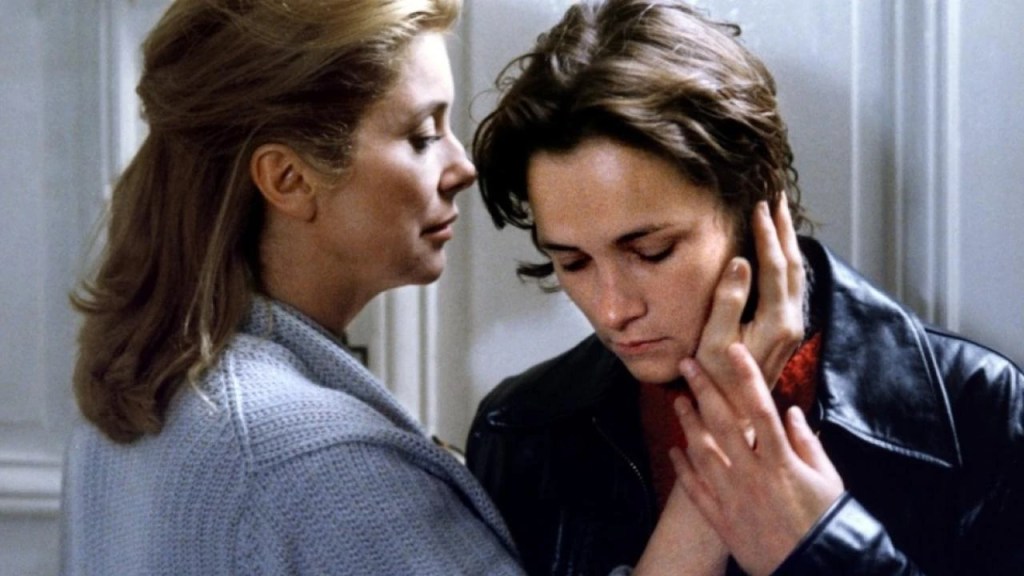
Téchiné returned to direct Deneuve again with this complicated drama of petty thieves in Lyon.
Laurence Côte plays a young delinquent named Juliette, who is the object of affection of both Alex – a cop (played by Daniel Auteuil) – and a middle-aged philosophy professor called Marie (Deneuve) who has fallen for a woman for the first time.
The movie begins with the death of the leader of a gang of thieves, Ivan, who is Alex’s brother.
The movie then goes backward and forward to reveal what led to the murder, and to unravel the complicated, messy romantic relationships and entanglement that connect Juliette, Alex and Marie.
I have watched this movie a few times, each time trying to examine it closely. I try to grasp the brilliance of this movie in its entirety and to uncover its enigmas but I have found it is impossible to do so.
Téchiné has set up an intricate drama that goes well beyond a typical cop-and-robber story. It is about organised crime, about sexuality, about loneliness, but also much, much more.
Deneuve delivers one of her finest performances in her later years. I am touched by the rawness and tenderness of the relationship between Marie and Juliette.
Deneuve’s acting is subtle as usual, so whoever expects theatrics and dramatic gestures will be disappointed. You have to pay close attention to the subtle facial expressions and inflection of voice.
Here, she plays a lonely middle-age professor, who waxes philosophy and drinks whiskey in the afternoon, unable to hide her wrinkles, who has fallen madly in love with her student Juliette, that she falls into depression when Juliette goes absent.
Juliette is wild, unstable, a thief of perfumes and other things. She admires her professor very much. She has sex with Alex but makes love to Marie, though we never are quite exposed to these scenes of them doing so, but rather have to imagine it.
Perhaps Téchiné conceals this to show the intimacy between the women, in contrast to the brute, almost animal-like sex between Alex and Juliette.
We are, however, presented with a rare gem in lesbian cinematic history where Marie and Juliette have an evening wash in a bathtub. Both women are tender in their love for each other.
Speaking about this scene in an interview, Deneuve said, “It’s as if it is a love scene between two people who love each other. You feel the relationship, not from kissing and making love (but) because it’s what it says about their characters, what they bring to each other, which is quite soft and tender.”
In Thieves, Téchiné manages to once again dig deep into Deneuve’s understated brilliance.
- Persepolis (2007, directed by Marjane Satrapi and Vincent Paronnaud)
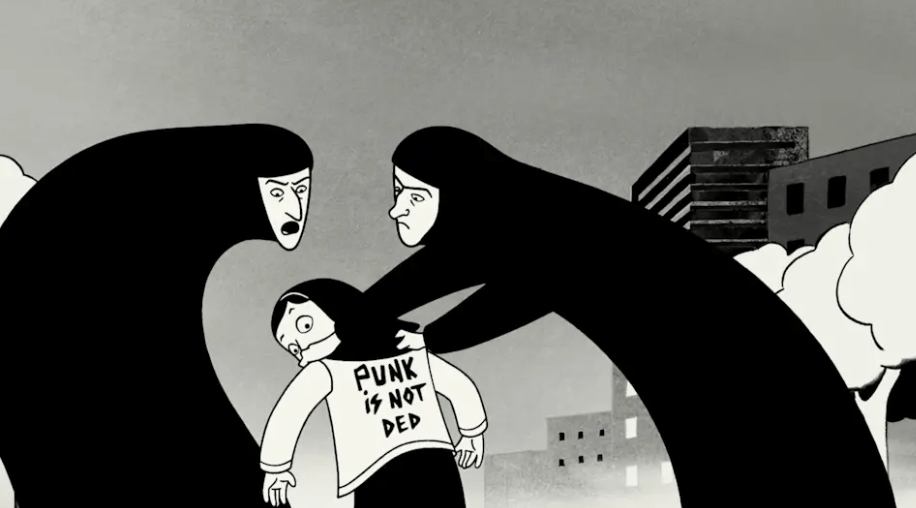
Real-life mother-daughter duo Catherine Deneuve and Chiara Mastroianni lend their voices to Persepolis—an animated film that is equal parts sad and funny—based on the graphic novel of the same name by Marjane Satrapi.
Persepolis recounts Satrapi’s comfortable childhood in Iran and how that comfort was stripped away by the Islamic revolution of 1979, which saw Ayatollah Khomeini overthrow the Shah and rise to power.
Satrapi grew up in a somewhat upper-middle-class family in Tehran and attended the French lycée. She played freely with friends and, even as a child, pondered the ideas of Lenin and Marx — two pivotal thinkers whose ideologies helped fuel resistance against the Shah and later in attempts against the Muslim fundamentalists who came to power.
When her parents sent her to study in Vienna, Satrapi suffered a breakdown as she struggled to reconcile the privilege of being able to escape both her country’s oppressive regime and the 1980 to 1988 Iran-Iraq war.
Exposed to her parents’ open-mindedness and forward-thinking values, Satrapi often clashed with Iranian authorities who enforced mandatory hijab laws and other sexist laws on women. Even her seemingly progressive peers held surprisingly conservative views, alienating her even more.
It is both endearing and heartbreaking to watch Satrapi navigate the stifling bureaucracy and cultural norms designed to control Iranian women’s lives.
This is a film for anyone who wants to laugh and cry at the same time. It is a deeply personal, yet universal story especially in today’s global politics which sees authoritarian governments returning to power.
- A Christmas Tale (2008, directed by Arnaud Desplechin)

Eccentric and hilarious, this movie is somewhat like a French version of The Royal Tenenbaums.
Deneuve plays Junon, the charismatic and somewhat overbearing matriarch of the Vuillard family. She is well-loved by her husband (who is pliant and indulges in her antics), her children, and her grandchildren – except for one family member: her son Matthieu, the odd one out, who resents his mother and whom Juno hasn’t seen in years.
One Christmas, Matthieu pays a visit to the family home, much to Junon’s annoyance. But when she is diagnosed with a rare form of cancer and learns that only Matthieu can provide the transplant she desperately needs, she is forced to choose whether to make amends with him.
Desplechin knows how to navigate humour with drama. We’re taken on a journey through the Vuillard family’s conflicts and shenanigans, though sometimes the movie does get unbearable with its quirks.
In one scene, Matthieu says he has never loved Junon, and she chuckles and says she never really loved him either.
A Christmas Tale is an intelligent and dark family dramedy not to be missed.
- On My Way (2013, directed by Emmanuelle Bercot)
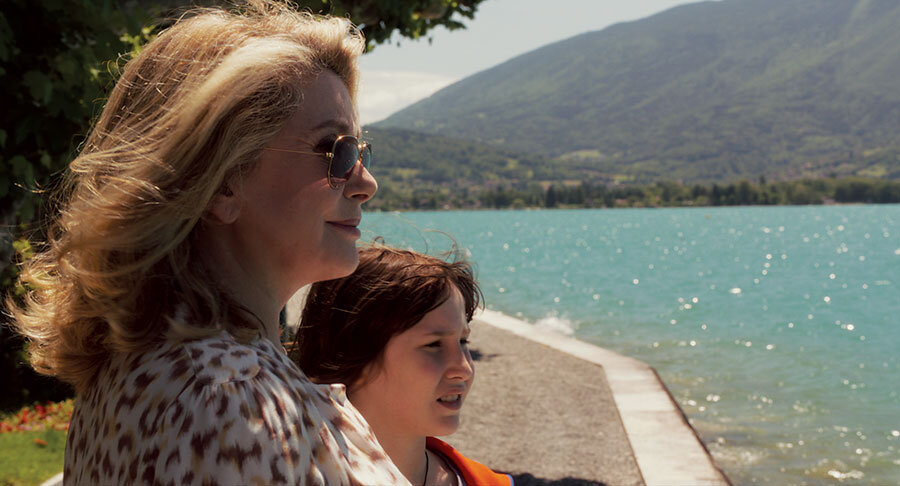
Stripped of her glamour, yet still so beautiful in her golden years, Deneuve plays Bettie whose life as a restaurant owner in a small provincial town gets thrown apart when her married businessman lover announces he is in love with a much younger woman.
Meanwhile, her estranged hippie daughter calls and requests Bertie to send her prepubescent son Charly cross country to his grandfather.
Deneuve’s character in this family movie departs from her ice queen public persona, and feels real. The interaction and rapport between her and the boy that plays her grandson also feels genuine.
The movie poses the question: how do we rebuild our lives after failure and heartbreak? And what can we do to kill the monotony of the routine that we have carved out for years to survive, especially for us women as we have been conditioned to play small since young?
Make no mistake: this movie is not French gourmet. This is just a feel-good family-friendly movie to enjoy on a quiet evening, and that is enough.
—
Mohani Niza is the founder and editor of The Culture Review Mag. Email her at mohani@tcrmag.com
 The Culture Review Mag
Leave a comment